DEPLOY - DETECT - DISCOVER
PlastiSwarm
The world's first automated swarm of buoys for microplastic detection.
Definition
What are Microplastics?
Microplastics are small plastic particles in the environment generally under 5mm in size.

introduction
The Problem
Microplastics impact not just marine ecosystems, but human health as well. Currently, there is no large-scale, quantifiable data on microplastics.
358 trillion microplastics are in our oceans, with an added 14 billion particles every year.
These microplastics are ingested by marine life such as zooplankton, destroying marine ecosystems.
These effects travel up the food chain, and eventually end up harming humans. Microplastics have been linked to cancer, reproductive issues, heart attacks, and other health concerns.
There is currently no efficient out-of-lab approach to collecting data about microplastic contents in different areas. This means that scientists do not know the areas most at risk.
358 Trillion
microplastics float in our oceans.
$19 Billion
is the cost of environmental plastics to the global economy each year.
8.5 Million Tons
of plastics enter our rivers, coasts and oceans each year.
Progress
Currently, PlastiSwarm is in a design and prototyping stage, with a field-testing model under development. We are looking to expand knowledge and awareness about both PlastiSwarm and microplastic pollution.
Our Team
Our team has been involved in both conservation and robotics from a young age. We are dedicated to protecting our local waterways and combatting plastic pollution.

Krish Stauber - CTO - Cofounder

Isha Stauber - COO - Cofounder
Contact Us
Feel free to reach out to us with partnership inquiries or to learn more about the creation of PlastiSwarm!
Thank you
We appreciate your commitment to fighting microplastic pollution!
What is plastiswarm?
Our Solution
PlastiSwarm is a swarm of automated buoys designed with a filter and onboard AI system to recognize and quantify microplastics in our waterways. Collaboratively, the buoys communicate to identify target areas for plastic cleanup.


Under the Surface
Water Intake
The water intake brings water in for sampling
Version 1.0
In the first version of PlastiSwarm, the water intake system was designed for speed and efficiency. Made of 6 peristaltic pumps, this design allowed for fast intake of water, compromising control. Additionally, due to the intensive work that would occur to manufacture a custom design of this part, this version was retired.
Version 1.1
In the second iteration of PlastiSwarm V1.0, the custom water intake design was replaced with a commercial-off-the-shelf variety. This choice was made due to manufacturing tolerance restrictions, and a purchased pump would provide tested accuracy necessary for the new design choices in V1.1. As stated later, in V1.1, the intake water is used for dilution of Nile red dye, and the accuracy of that solution is critical to success.
Filter Chamber
The filter chamber captures microplastics from the water to be imaged
Version 1.0
In V1.0, the filter chamber was basic, relying on only one filter which would be reused after an automated cleaning. The conclusion was that this design would wear out quickly and produce unpredictable results. For this reason V1.0 was used for sample imagery and testing and later retired.
Version 1.1
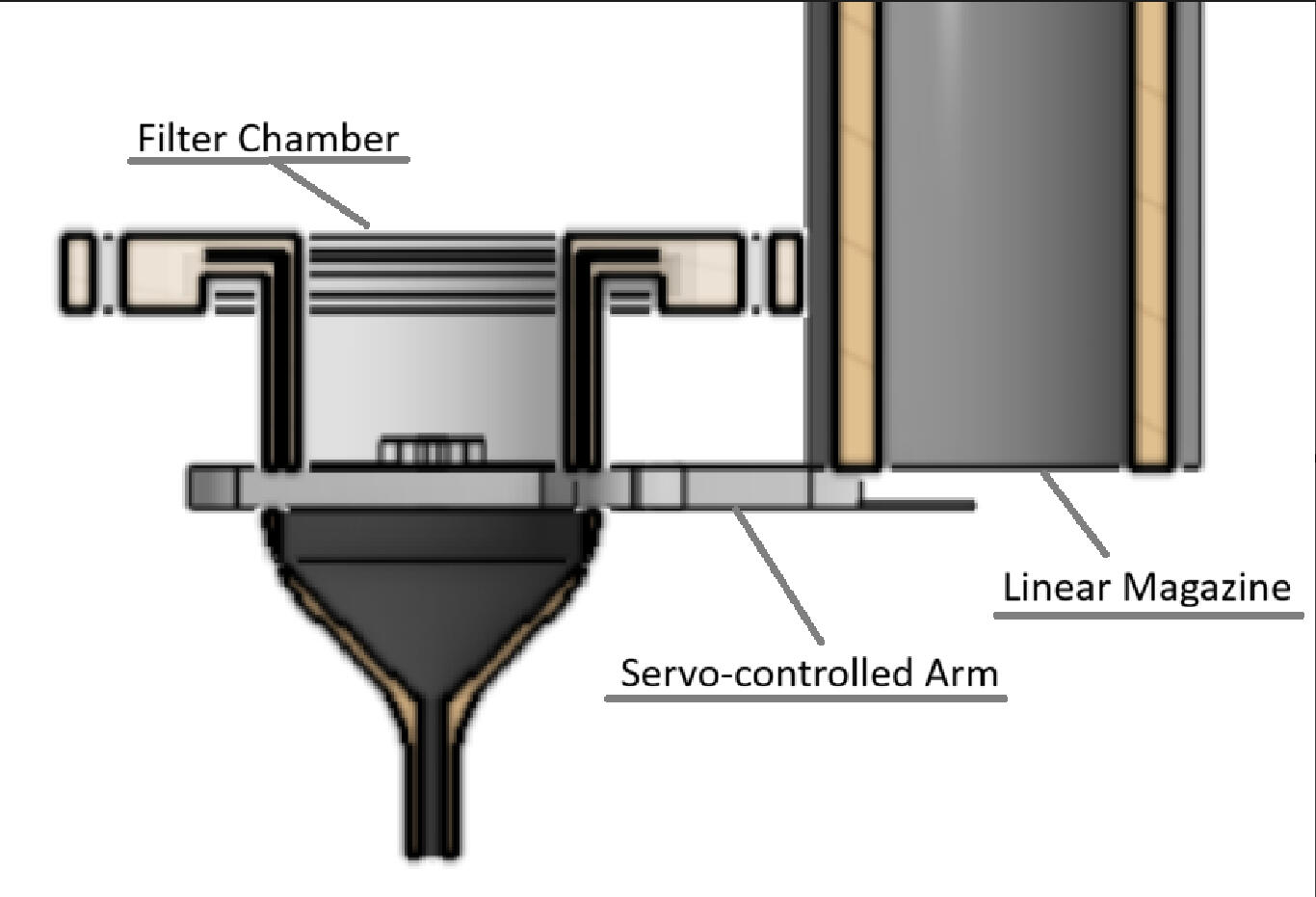
To address the issues developed in V1.0, V1.1 uses a linear magazine of one-time use filters, which are swapped using a servo-driven arm. This solution allows for many trials to be completed without cross-contamination, although a solution is being derived to provide more vertical space for filter storage.
Dye & DI Water Syringes
These precision mechanisms provide accurate amounts of fluid to stain and clean up microplastics on the filter
Version 1.0
In the prototype version of PlastiSwarm, there was a single rack-and-pinion driven syringe to allow for the addition of a Nile red dye solution. This proved invaluable to the later improvements, but lacked a proper way to rinse out the filter and lower drainage aparattus.
Version 1.1
V1.1 saw the addition of another syringe-based pump for the insertion of distilled water. This is used to clean off the drainage surface, below the filter for a clear, uncontaminated space to continue testing under a new filter.
Waste Chamber
The waste chamber stores used filters and liquids until the unit is serviced
Version 1.0
Version 1.0 did not have a waste chamber. Due to the prototype status of this probe, it was never meant to go into real production and so the waste chamber was not added to allow for focus on the novel parts of the design. The design of this chamber was sketched but not CADded
Version 1.1
V1.1 had the first true waste chamber. This chamber is located in a secluded area away from electronics and test areas to avoid damage and contamination. For solid waste, currently only the filters, the waste chamber is simply passive, storing the filters as they fall. The liquid part of the waste chamber has a peristaltic pump, which removes the solution from the testing area once the sample has soaked in the dye.
Isn't this contradictory? One time filters create waste...
You're right to be skeptical. However, the filters themselves are biodegradable, and there is a plastic ring around them, to allow for insertion into the linear magazine. This can be twisted off and added to a new filter, allowing for repeated reuse.
Lab Setup
The filter chamber provides a quantifiable reading on microplastics
The lab setup consists of a digital microscope located over the filter chamber. The specific type of filter mesh was chosen to reduce background noise in the imaging. When water is initially filtered, a set amount is taken in, and then diluted with Nile red dye. After sitting for 30 minutes, the water is then flushed out, leaving the filtered plastics on the mesh. A UV light, in the 405-500 nm range shines on the mesh, causing microplastics to flouresce, and the data is collected and processed by the onboard Jetson Orin Nano computer.